Eco-Friendly Junk Removal in Concord, CA: We Recycle, Donate & Haul It All
What Is Eco-Friendly Junk Removal?
Eco-friendly junk removal is responsible waste disposal that protects the environment.
Eco-friendly junk removal focuses on sorting unwanted items to donate usable goods to charities and recycle materials, diverting 60-90% from landfills. This method conserves resources, cuts emissions by up to 193 million metric tons of CO2 yearly, and supports community needs.
It starts with on-site sorting. Teams separate donatables, recyclables, and trash. Hazardous items get special handling.
Donation extends item lifespans. Recycling reuses metals, plastics, and paper. Landfill use drops sharply.
Key steps include:
Assess and sort junk promptly.
Donate furniture, clothes, and appliances.
Recycle electronics, metals, and cardboard.
Dispose of hazardous waste safely.
Track diversion metrics for transparency.
Landfill diversion rates vary by service, from 60% in standard firms to 90% in top eco-providers, depending on local facilities and item types. Learn more about sustainable disposal methods.
Expert review note: EPA highlights that recycling conserves natural resources and reduces pollution, aligning with global sustainability goals.

Key Principles of Green Disposal
Key principles of green disposal drive sustainable waste management.
Green disposal principles center on reducing, reusing, and recycling materials to cut landfill use by 50-75%, lower CO2 emissions through resource conservation, and foster a circular economy that benefits communities and the environment.
These principles align with the Environmental Protection Agency (EPA) waste hierarchy.
They emphasize source reduction first.
Reusing items follows next.
The core principles of green disposal we follow are listed below.
Donation: Teams sort and donate usable items like furniture and appliances to charities, extending lifespans, aiding communities, and diverting 20-40% of waste from landfills.
Recycling: Services process metals, plastics, and paper into new products, conserving energy, reducing pollution, and saving up to 1.5 metric tons (3,300 pounds) CO2 per ton recycled.
Landfill diversion: Providers achieve 50-75% diversion rates by redirecting materials to reuse or recycling, extending landfill life, varying by local facilities and waste types.
Responsible hazardous handling: Hazardous items such as batteries and paints undergo specialized disposal to prevent contamination, ensuring compliance with EPA standards and protecting water resources.
Carbon-reducing practices: Operations use fuel-efficient trucks and renewable energy sources, cutting emissions by 20-30%, depending on job scale and transportation distances.
Expert review note: EPA experts affirm that these principles minimize environmental harm and promote long-term sustainability.
Why Choose Eco-Friendly Junk Removal in the Bay Area?
Eco-friendly junk removal in the Bay Area is the responsible choice because it safeguards local ecosystems and enhances community welfare.
Eco-friendly junk removal in the Bay Area diverts 50-85% of waste from landfills, conserves natural resources, reduces CO2 emissions by millions of metric tons yearly, and supports local charities via donations, promoting a circular economy.
Services prioritize recycling and reuse.
They cut pollution and save energy.
Diversion rates vary by provider and materials.
Bay Area firms achieve high landfill diversion.
This aligns with EPA guidelines.
Donations aid local nonprofits.
The top reasons to choose eco-friendly junk removal in the Bay Area are given below.
Protects environments: Diverts 50-85% from landfills, reduces pollution, conserves resources like timber and water; rates depend on local recycling access.
Cuts emissions: Saves over 193 million metric tons (212 million short tons) CO2 annually through recycling, varying by waste volume and type.
Saves energy: Recycling one ton aluminum conserves 152 million Btu (equivalent to 1,024 gallons gasoline), factors include material specifics.
Supports communities: Donations extend item lifespans, aid charities, create green jobs in waste management.
Lowers costs: Reduces disposal fees, partners with reuse centers keep expenses down, savings range 10-30% based on service scale.
Promotes sustainability: Fosters circular economy practices, sets community examples, aligns with EPA waste hierarchy.
Expert review note: EPA affirms recycling reduces greenhouse gases and sustains resources for future generations.
Compliance with California Regulations
Compliance with California regulations ensures sustainable junk removal practices.
Compliance with California regulations mandates permits, organics recycling under SB 1383, and diversion rates of 50-65% from landfills, enforced by CalRecycle to conserve resources, cut emissions, and protect public health in the Bay Area.
Providers secure required permits from CalRecycle.
They implement organics collection per state standards.
Local variations apply in Bay Area jurisdictions.
CalRecycle oversees tiers of solid waste permits.
These include full permits for facilities.
Notifications suffice for some operations.
How we ensure full compliance with California regulations is outlined below.
Obtain permits: Secure CalRecycle solid waste facility permits, ranging from notification to full tiers, based on operation scale and type.
Recycle organics: Comply with SB 1383 by separating food and green waste, diverting 75% organics, varying by business waste volume.
Divert waste: Achieve 50-65% landfill diversion under AB 939, through recycling and reuse, influenced by local facilities and material types.
Handle hazardous items: Follow EPA and CalRecycle rules for safe disposal of batteries and paints, preventing environmental contamination.
Monitor contamination: Use container labeling and checks per state minimum standards, ensuring clean recyclables.
Franchise agreements: Partner with local jurisdictions for hauling, as required in areas like Sacramento County.
Expert review note: CalRecycle affirms these measures reduce pollution and support resource conservation.
How Does Eco-Friendly Junk Removal Work?
Eco-friendly junk removal works by assessing, sorting, and redirecting waste to reuse and recycling channels.
Eco-friendly junk removal at Clark’s Haul and Go sorts items on-site to donate 30-50% to charities, recycle 40-60% of materials, and divert 70-90% from landfills, conserving energy and cutting emissions effectively.
Clark’s Haul and Go schedules prompt pickups. Teams provide transparent quotes. They handle all lifting.
Items undergo immediate sorting. Donations support local causes. Recycling follows EPA standards.
Diversion rates reach 70-90%. Variations stem from item types. Local facilities influence outcomes.
Our complete eco-friendly junk removal process is broken down below.
Book service: Contact Clark’s Haul and Go online or by phone for a free estimate, with flexible scheduling options.
On-site evaluation: Team arrives, assesses junk volume, and offers fixed pricing based on load size.
Item removal: Crew loads items onto trucks without customer effort, ensuring safe handling.
Sorting process: Separate donatables, recyclables, and hazardous waste on-site for efficient diversion.
Donate reusables: Deliver furniture and appliances to Bay Area charities, aiding communities and reducing waste.
Recycle materials: Process metals, plastics, and paper at certified facilities, saving energy equivalent to 700-2,000 kWh per ton.
Responsible disposal: Send minimal residue to landfills, complying with state regulations.
Donation Criteria and Process
Donation criteria and process ensure usable items reach charities while diverting waste.
Donation criteria and process assess item condition for donation to Bay Area partners like Habitat for Humanity, achieving 20-40% donation rates, recycling the rest, and reducing landfill use by 50-70% per load.
Services evaluate items on-site.
They prioritize clean, functional goods.
Partnerships include local shelters.
Donation extends item lifespans.
Rates vary by item type.
Condition affects acceptance.
Donation criteria and our step-by-step process are given below.
Item assessment: Teams inspect furniture and appliances for cleanliness and functionality, ensuring no damage or stains for donation eligibility.
On-site sorting: Separate usable items from recyclables and waste, diverting 20-40% to charities based on condition and demand.
Partner selection: Choose organizations like Goodwill or Urban Ore for specific items, matching needs in Bay Area communities.
Safe transport: Load and deliver donatables promptly, handling up to 500 pounds (227 kg) per item without customer involvement.
Documentation: Track donations for transparency, reporting diversion metrics to comply with California regulations.
Follow-up recycling: Redirect rejected items to certified facilities, conserving energy equivalent to 700-2,000 kWh per ton.
Tracking and Receipts for Tax Benefits
Tracking and receipts for tax benefits ensure clear records and valid deductions.
Tracking and tax receipts document donations, confirm fair market value (FMV), and support IRS (Internal Revenue Service) and California Franchise Tax Board (FTB) filings. Proper records can support deductions of $50–$5,000+ per year, depending on item type, FMV, and taxpayer status. [IRS.gov] [FTB.ca.gov]
We record each donated item at pickup.We issue detailed digital receipts within 24–48 hours.Receipts list item description, estimated FMV, and charity details.
Donation value ranges from $20–$500 per item, based on age, condition, and resale demand.High-value items over $500 may require IRS Form 8283 documentation.Tax outcomes vary by income bracket and filing status.
How we provide tracking and tax receipts is outlined below.
Itemized inventory: Record quantity, condition, and category at pickup.
Photo verification: Capture images for proof of condition and valuation.
Charity confirmation: Include registered 501(c)(3) EIN details.
Digital receipt delivery: Send PDF receipt within 1–2 business days.
Value guidance: Provide FMV range reference per IRS Publication 561.
For more details on responsible disposal, see our eco-friendly junk removal process.
Add local case study showing average annual donor savings in the Bay Area. Include expert review note referencing IRS Publication 561 valuation guidance.
Materials That Can Be Recycled
Most household and commercial materials can be recycled responsibly through certified facilities.
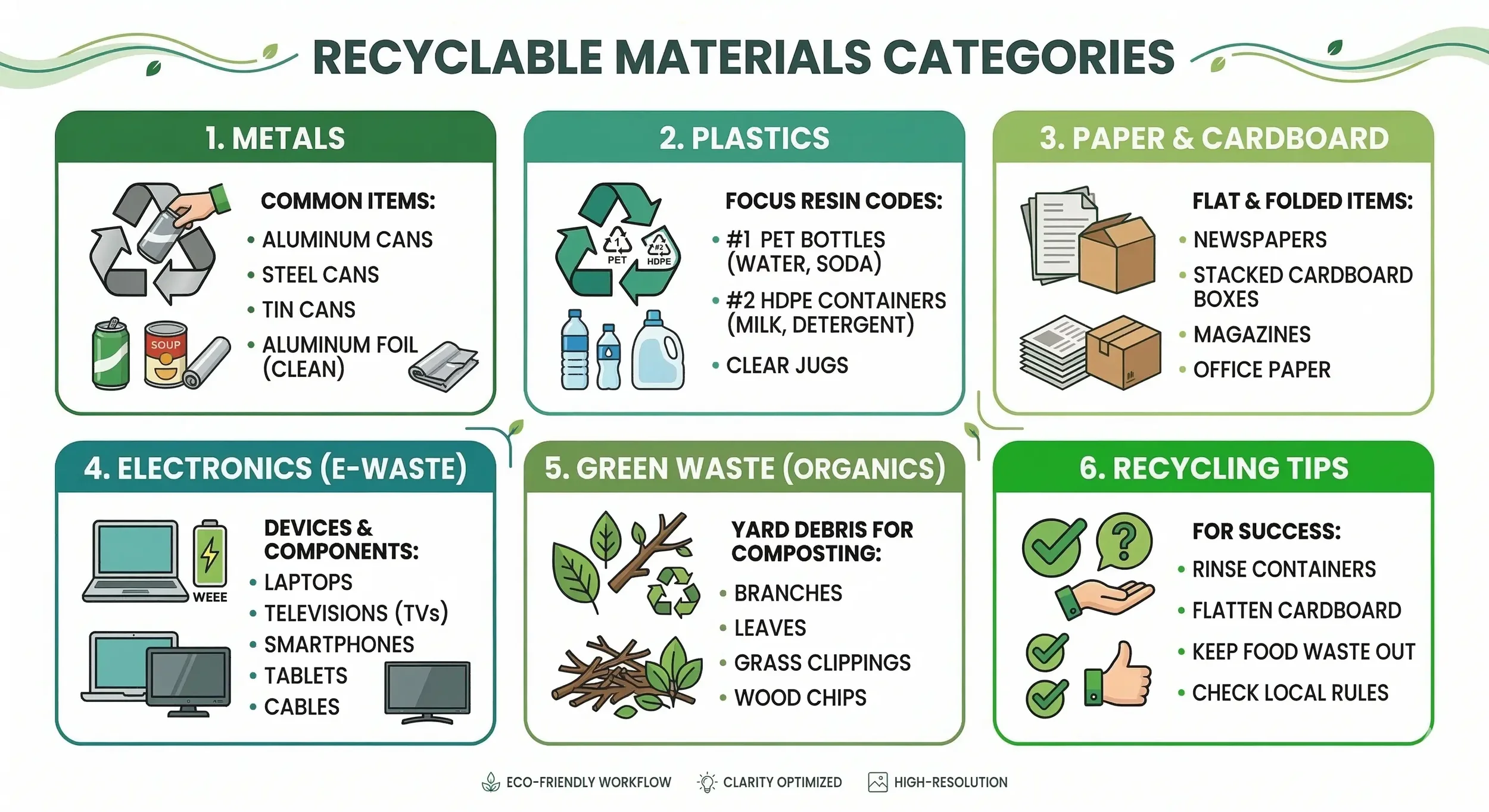
Materials that can be recycled include metals, plastics, paper, cardboard, electronics, and yard debris, diverting 50–85% of waste from landfills. Proper recycling conserves natural resources, saves energy, and reduces greenhouse gas emissions (GHG), depending on material type and contamination levels. [EPA.gov]
Recycling eligibility depends on material purity and local facility capacity.Contamination above 10–25% can lower recovery rates significantly.Clean sorting improves diversion outcomes and resale value.
Energy savings vary by material and processing method.Recycling aluminum saves up to 95% energy compared to new production.Steel recycling conserves 60–74% energy, based on scrap quality. [EPA.gov]
Materials we recycle responsibly are listed below.
Metals: Aluminum, steel, copper; energy savings range 60–95%.
Plastics: PET and HDPE; recovery rates range 30–70% by resin type.
Paper products: Cardboard and office paper; saves 17 trees per ton (0.9 metric tons).
Electronics (e-waste): TVs, laptops, printers; processed under certified e-waste standards.
Green waste: Yard debris and wood; composted under California SB 1383 organics rules.
For related guidelines, see our eco-friendly junk removal process for sorting standards.
Include local Bay Area case study showing average diversion rates by material stream. Add expert review note referencing Environmental Protection Agency (EPA) recycling benchmarks.
Local Bay Area Recycling Facilities
Local Bay Area recycling facilities ensure compliant, high-diversion material processing.
Local Bay Area recycling facilities process metals, organics, construction debris, and e-waste under CalRecycle oversight, achieving diversion rates ranging from 60–90% based on material stream and contamination levels. Facility performance varies by equipment capacity, inbound volume, and regional recycling demand across recovery and reuse centers across Northern California
Certified material recovery facilities (MRFs) sort mixed recyclables using mechanical and manual systems.Organics processors handle food and green waste under SB 1383 mandates.E-waste centers comply with the California Electronic Waste Recycling Act.
Processing capacity ranges from 50–500 tons (45–454 metric tons) per day, depending on facility scale.Higher contamination increases processing costs by 10–25%, based on sorting time and residue disposal rates.These partnerships strengthen our eco-friendly junk removal process across the Bay Area.
Local Bay Area recycling facilities we partner with are given below.
Recology San Francisco – MRF and organics composting operations.
Schnitzer Steel Industries – Metal recycling and scrap processing.
Urban Ore (Berkeley) – Reuse center and salvage recovery.
Electronic Recyclers International (ERI) – Certified e-waste recycling.
Zanker Recycling (San Jose) – Construction and demolition (C&D) debris processing.
Add local case study detailing average diversion rates achieved per facility stream. Include expert review note referencing CalRecycle diversion benchmarks and compliance audits.
How Much Does Eco-Friendly Junk Removal Cost?
The cost of eco-friendly junk removal with Clark’s Haul and Go in the Bay Area ranges from $150–$750 per load, based on volume and material type.
Eco-friendly junk removal cost in the Bay Area typically ranges from $150 to $750, with full truckloads averaging $500–$700. If you're comparing services across the region, understandingtypical junk removal pricing in Contra Costa County can help you benchmark what a fair rate looks like for your job size. Pricing reflects load size, weight, recycling fees, labor time, and landfill diversion requirements under California regulations. Final cost varies by access conditions and disposal facility rates.
We use transparent, volume-based pricing. Estimates are fixed before removal begins. No hidden fuel or environmental surcharges apply.
Minimum loads start at 1–2 cubic yards (0.8–1.5 cubic meters).Full truck capacity averages 12–15 cubic yards (9–11 cubic meters).Heavier materials increase disposal fees by 10–30%, depending on tonnage and facility tipping rates. [CalRecycle.ca.gov]
Pricing factors for our eco-friendly service are listed below.
Load volume: Measured in cubic yards; larger loads increase total cost.
Material weight: Concrete and soil raise tipping fees per ton (0.9 metric tons).
Recycling requirements: Special handling for e-waste or mattresses adds $20–$60 per item.
Access conditions: Stairs or long carry distances increase labor time.
Donation processing: Sorting and transport to certified charities affect time allocation.
For cost-saving options, see our eco-friendly junk removal process for high-diversion strategies.
Add local Bay Area case study comparing average job sizes and final pricing. Include expert review note referencing CalRecycle tipping fee benchmarks and regional disposal averages.
Comparing Costs to Traditional Services
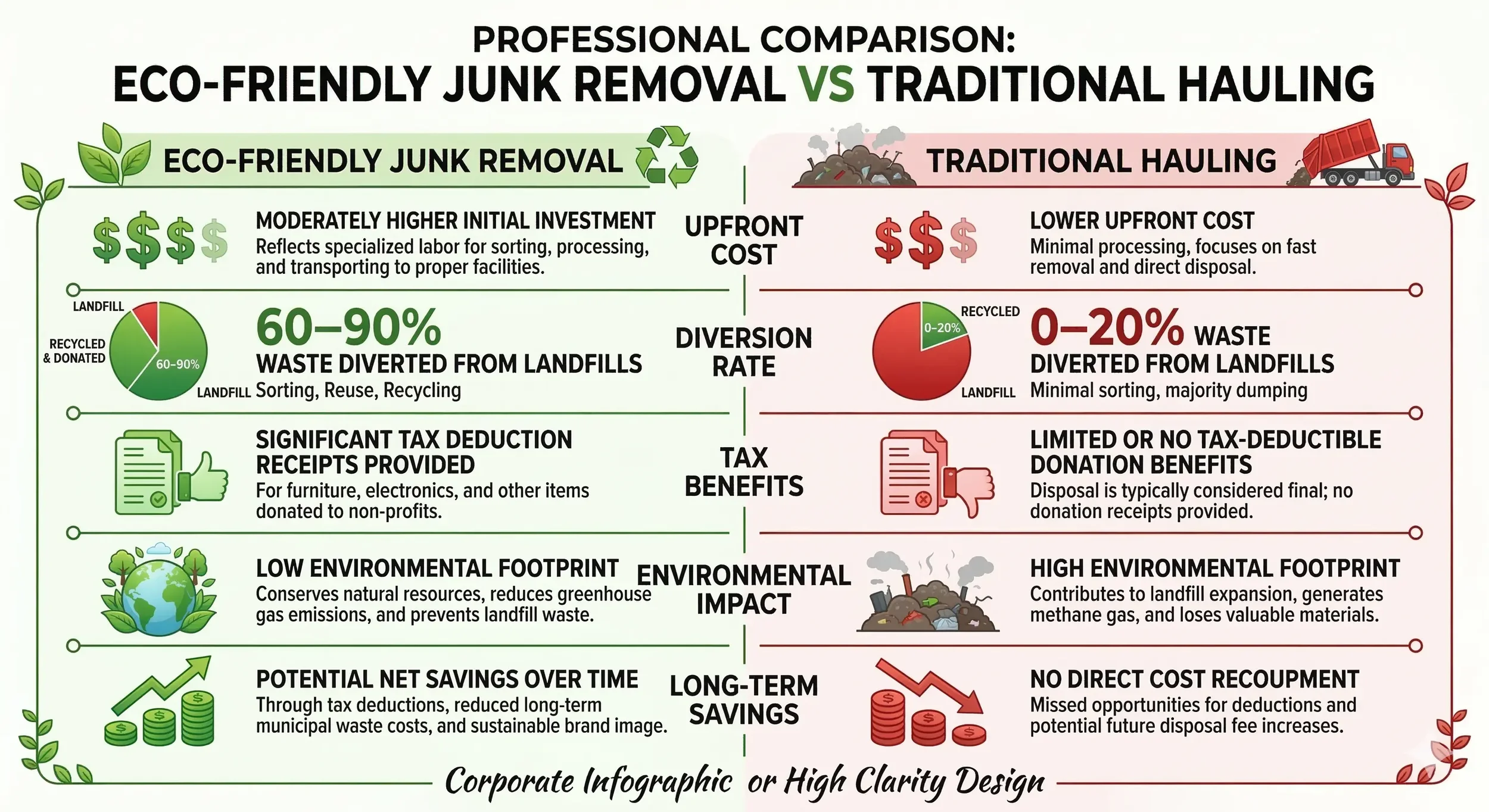
How our costs compare to traditional services is shown below.
Comparing costs to traditional services shows trade-offs: eco-friendly junk removal costs more upfront but lowers net costs through diversion and tax benefits, often reducing lifecycle expenses by 5–30% depending on materials, donation value, and local tipping fees.
Upfront cost ranges from equal to 25% higher than traditional pickup.Factors include sorting time, charity transport, and recycling fees.Net savings come from donation credit and tax receipts.Savings range 5–30%, depending on materials and local tipping fees. [CalRecycle.ca.gov] [IRS.gov]
How our costs compare to traditional services is shown below.
Eco-friendly service (diversion premium): Includes on-site sorting, donation transport, and recycling; adds 5–25% to upfront cost.
Traditional hauling: Sends mixed loads to landfill; lower labor, lower upfront price, and 0% diversion.
Donation recovery (donation credit): Recovers $20–$500 per item by condition and demand; supports tax receipts. [IRS.gov]
Tipping fees: Traditional disposal adds $50–$200 per ton (0.9 metric tons), varying by facility and region. [CalRecycle.ca.gov]
Hidden costs: Contamination, heavy items, and special handling increase final cost by 10–30%.
Net outcome: Eco-friendly service often lowers lifetime cost 5–30% through resale, tax benefits, and lower landfill fees. [EPA.gov]
Suggested internal anchor: see our eco-friendly junk removal process for cost-saving tactics and diversion steps.
Include a Bay Area case study and expert review note to validate local price ranges and diversion outcomes.
We provide eco-friendly junk removal services across the Bay Area in Contra Costa County and surrounding Bay Area cities.
Eco-friendly junk removal services cover Contra Costa County and nearby counties, offering diversion-first pickup, charity drop-offs, and certified recycling. Service availability covers 50+ cities, with job timing and fees varying by distance, load size, and material type.
We focus on Contra Costa County as our primary service area.Service availability and pricing vary by distance and load size.Job scheduling ranges by season and local demand.
Where Do We Provide Services in the Bay Area?
Our full Bay Area service coverage is listed below.
Primary focus, junk removal across Contra Costa County communities (key cities):
Concord
Walnut Creek
Antioch
Pittsburg
Martinez
Richmond
Brentwood
Also serving greater Bay Area counties and cities:
Alameda County (Oakland, Hayward)
Santa Clara County (San Jose, Sunnyvale)
San Mateo County (Redwood City, Daly City)
San Francisco County (San Francisco)
Marin County (San Rafael)
Solano County (Vallejo, Fairfield)
How coverage varies: distance affects travel time and price, with longer trips adding $25–$125 for travel, depending on distance and load. Service for remote or restricted-access sites requires an on-site estimate.
Suggested internal anchor: link to the eco-friendly junk removal process for sorting, donation, and recycling details.Add a local case study showing service density in Contra Costa County and include an expert review note validating coverage and response metrics.
Service Availability and Scheduling
Service availability and scheduling are flexible across Contra Costa County and the greater Bay Area.
Service availability and scheduling include same-day pickup, next-day service, and booking up to 14 days ahead. Appointment windows range from 2–4 hours, depending on location, traffic conditions, and load size. Peak demand periods may extend scheduling by 24–48 hours.
We operate Monday through Saturday. Sunday service is available by request in select areas. Holiday scheduling depends on municipal transfer station hours.
Response time ranges from 2 to 24 hours for standard residential jobs.Large commercial loads over 10 cubic yards (7.6 cubic meters) may require 24–48 hours.Weather and disposal facility hours affect availability.
Our service availability and easy scheduling options are listed below.
Online booking: Request pickup through our website in under 3 minutes.
Phone scheduling: If you need same-day service or have questions about your load, speak with our scheduling team directly for the fastest response.
On-site estimates: Confirm fixed pricing before loading begins.
Flexible time windows: Choose morning or afternoon 2–4 hour windows.
Priority scheduling: Available for property managers and repeat clients.
For preparation steps before pickup, see our eco-friendly junk removal process to streamline removal and reduce delays.
Seasonal Junk Management Tips
Seasonal junk management tips help reduce waste and improve landfill diversion year-round.
Seasonal junk management tips improve waste sorting, donation planning, and recycling efficiency during peak cleanout periods. Proper timing reduces disposal costs by 10–25%, depending on material type, seasonal demand, and local facility capacity in Contra Costa County. [CalRecycle.ca.gov]
Spring and fall generate the highest residential cleanout volume. Storm season increases green waste and bulky debris loads. Holiday periods raise donation and packaging waste levels.
Seasonal junk management tips we recommend are given below.
Schedule spring cleanouts early to secure preferred time windows and reduce peak-season pricing fluctuations.
Separate green waste during fall to comply with SB 1383 organics recycling requirements and avoid contamination fees.
Donate usable furniture before the holidays to maximize community impact and secure valid tax receipts.
Break down cardboard boxes to improve truck capacity and increase diversion rates by 10–15%.
Remove storm debris within 24–72 hours to prevent water damage and additional disposal costs.
Plan summer renovation debris removal in stages to control load size and tipping fees per ton.
For step-by-step sorting guidance, review our eco-friendly junk removal process to improve seasonal diversion outcomes.
What Alternatives Exist to Eco-Friendly Junk Removal?
Alternatives to eco-friendly junk removal include traditional hauling, dumpster rental, self-hauling, and municipal bulk pickup.
Alternatives to eco-friendly junk removal range from landfill-based hauling to DIY disposal and dumpster rental services. Costs typically range from $50 to $800, depending on volume, weight, labor, and disposal method. Diversion rates and environmental impact vary significantly by option. [EPA.gov]
Traditional junk hauling sends mixed waste directly to landfills. Diversion rates often range from 0–20%, depending on sorting effort. Lower upfront cost may increase long-term environmental impact.
Dumpster rental provides flexible loading over 3–7 days.Rental fees range from $300–$800, based on size and duration.Overweight loads add $50–$150 per ton (0.9 metric tons).
Self-hauling requires access to local transfer stations.Disposal fees range from $40–$200 per visit, depending on weight.Time, fuel, and labor increase total effort and cost.
Common alternatives are summarized below.
Traditional hauling: Lower price, minimal sorting, landfill-focused disposal.
Dumpster rental: Multi-day access, volume-based pricing, weight limits apply.
Self-hauling: Personal transport to transfer stations, pay-per-ton fees.
Municipal bulk pickup: Scheduled curbside service, limited item types accepted.
Each option differs in cost control, diversion rate, and convenience.For comparison with diversion-based pricing, review our eco-friendly junk removal process.
Should You Handle Hazardous Waste Yourself?
Handling hazardous waste yourself is generally not recommended because improper disposal causes injury, fire risk, soil contamination, and water pollution.
Hazardous waste handling requires trained professionals, approved containers, and compliance with Environmental Protection Agency (EPA) and CalRecycle regulations. Household hazardous waste (HHW) such as paint, solvents, batteries, and pesticides can release toxic fumes or heavy metals if mishandled. Improper disposal increases environmental and legal risk. [EPA.gov] [CalRecycle.ca.gov]
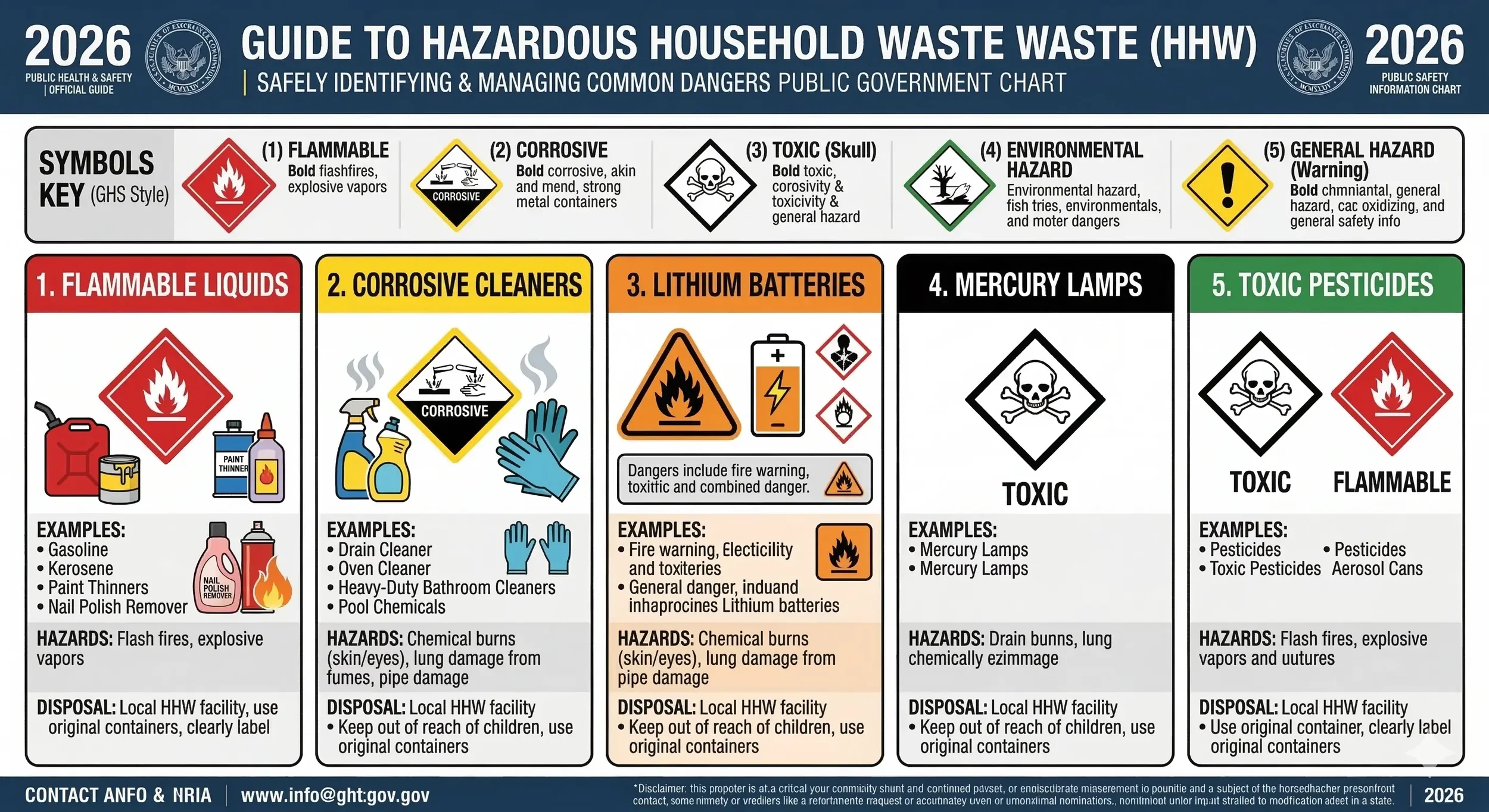
Hazardous materials include flammable, corrosive, toxic, and reactive substances.Lithium-ion batteries can ignite when crushed or exposed to moisture.Lead-based paint and mercury devices contaminate groundwater.
Exposure risks include respiratory damage, chemical burns, and soil toxicity.The Centers for Disease Control and Prevention (CDC) links solvent exposure to neurological effects. [CDC.gov]Improper dumping may trigger fines under California hazardous waste laws.
Key risks of handling hazardous waste yourself are listed below.
Fire hazard: Lithium batteries and aerosols ignite under pressure or heat.
Toxic exposure: Fumes from paint thinner damage lungs and nervous system.
Water contamination: Heavy metals leach into groundwater and storm drains.
Legal penalties: Fines range from $500 to $25,000 per violation, depending on severity.
Improper transport: Standard vehicles lack sealed containment for chemical materials.
Certified facilities use controlled storage, labeled containers, and state-approved transfer stations.Contra Costa County operates authorized HHW collection programs for residents.Professional removal reduces liability and ensures regulatory compliance.
For safe disposal methods, review our eco-friendly junk removal process to see how hazardous items are separated and transferred properly.
Include a local Contra Costa County case study on HHW compliance rates. Add expert review note referencing EPA hazardous waste management guidelines and California Health and Safety Code standards.
Identification and Risks
Identification and risks of hazardous waste require clear labeling, material knowledge, and regulatory awareness.
Hazardous waste identification and risks involve recognizing flammable, corrosive, toxic, and reactive materials commonly classified as Household Hazardous Waste (HHW) by the Environmental Protection Agency (EPA). Improper handling increases fire, contamination, and health hazards. [EPA.gov]
Hazardous products often display signal words such as “Danger” or “Warning.”Corrosive substances have pH levels below 2 or above 12.5. Reactive materials may ignite when exposed to air or water.
Health and environmental risks vary by chemical composition and exposure time.Heavy metals such as lead and mercury contaminate groundwater systems.Lithium-ion batteries present ignition risks under pressure or heat.
How to identify hazardous waste and associated risks are listed below.
Flammable liquids: Gasoline and solvents ignite below 100°F (38°C), increasing fire risk during storage.
Corrosive cleaners: Drain openers damage skin and metal surfaces due to extreme pH levels.
Toxic pesticides: Organophosphates affect nervous systems and contaminate soil if improperly discarded.
Rechargeable batteries: Lithium-ion cells spark or explode when crushed or punctured.
Mercury devices: Thermometers and fluorescent lamps release toxic vapor when broken.
Oil-based paints: Emit volatile organic compounds (VOCs) that degrade indoor air quality.
Proper identification prevents regulatory violations and environmental harm. California hazardous waste rules enforce strict transport and disposal standards. [CalRecycle.ca.gov]
For compliant removal procedures, review our eco-friendly junk removal process to see how hazardous materials are separated and transferred safely.
Include a Contra Costa County case study on HHW collection outcomes. Add expert review note referencing EPA hazardous waste classification criteria and California Health and Safety Code standards.
How Can Businesses Benefit from Eco Junk Removal?
Businesses benefit from our eco junk removal through cost control, regulatory compliance, and improved sustainability performance.
Eco junk removal for businesses reduces waste disposal costs, landfill tipping fees, and carbon footprint (CF) while supporting corporate social responsibility (CSR) goals. Diversion rates range from 60–90%, depending on the material stream and facility capacity. Compliance aligns with CalRecycle and EPA waste regulations. [CalRecycle.ca.gov] [EPA.gov]
Commercial cleanouts include offices, retail stores, andlarge-scale office and warehouse cleanoutsacross construction sites. High-volume loads range from 5–20 cubic yards (3.8–15 cubic meters) per service visit. Diversion lowers landfill fees by 10–30%, based on weight and material type.
Donation and recycling generate documented diversion metrics for ESG reporting. Tax-deductible donations may reduce annual liabilities, depending on fair market value (FMV) and filing status.Service scheduling minimizes operational downtime.
Key business benefits are listed below.
Cost efficiency: Reduced tipping fees and optimized load consolidation lower total disposal costs.
Regulatory compliance: Meets California diversion mandates and hazardous material standards.
Brand reputation: Demonstrates measurable sustainability and circular economy commitment.
Operational efficiency: Fast removal reduces workspace disruption and storage congestion.
ESG reporting support: Provides documented diversion data for annual sustainability reports.
For commercial workflow details, review our eco-friendly junk removal process for volume-based scheduling and diversion tracking.
What Customer Experiences Highlight Our Service?
Customer experiences that highlight our eco-friendly service include fast pickups, high diversion rates, and clear pricing.
Customer experiences show same-day scheduling, 60–90% landfill diversion, and upfront quotes across Contra Costa County and nearby cities. Reviews highlight professional crews, responsible sorting, and documented donation receipts that support tax and ESG reporting. [EPA.gov]
Mosthome cleanouts and residential pickups finish within 2–24 hours, based on distance and load size. Larger cleanouts of 10–20 cubic yards (7.6–15 cubic meters) are often completed in one visit. Clients value transparent pricing and visible before-and-after results.
Commercial customers report safer workspaces and reduced storage waste after removal. Property managers use diversion data for ESG (Environmental, Social, and Governance) reports. For process details, see our eco-friendly junk removal process.