Junk Removal East Bay: What to Expect
Junk removal in the East Bay follows a clear, simple process. It starts the moment you book and ends when the truck pulls away. Knowing each step helps the job move faster. This guide covers preparation, arrival, sorting, timing, your role, recycling, and payment.
How Does Junk Removal Preparation Work in the East Bay?
Junk removal preparation in the East Bay is surprisingly simple because most of the work falls on the crew. Your job is to clear the path and confirm your items. A few steps before the crew arrives, save 20 to 30 minutes on site.
The 7-day prep checklist for a stress-free East Bay junk removal is listed below.
What Checklist Prepares Your Home for Junk Removal?
The complete preparation checklist for East Bay residential junk removal is given below.
Walk through every room and identify all items for removal at least two days before pickup.
Move items you are keeping to a separate room or a clearly marked area.
Check parking rules in Oakland, Berkeley, Concord, or Antioch for your street.
Clear a direct path from each removal area to the nearest exit door.
Notify building management if the property is an apartment or townhome.
Label hazardous items like paints, solvents, and chemicals separately before the crew arrives.
Confirm your booking the night before and make sure an adult is present on the day.

How Much Advance Notice Does Junk Removal Require?
Most East Bay junk removal companies ask for 24 to 48 hours of advance notice. Clark's Haul and Go offers same-day junk removal across Contra Costa County and the East Bay. A morning call can result in an afternoon pickup the same day.
Same-day availability depends on crew location. Calling before 10:00 AM improves your chances of a same-day slot. For full home cleanouts or estate jobs, booking 2 to 3 days ahead ensures the right crew size and equipment arrive.
What Access and Parking Setup Does Junk Removal Need?
Access and parking requirements in Oakland, Berkeley, Concord, and Antioch are listed below.
Oakland and Berkeley have street cleaning schedules and permit zones. Check the city's parking portal for your block before the crew arrives.
Concord and Antioch allow curbside parking for service vehicles in most areas. Driveways and side-yard access are preferred when available.
Apartments and gated communities require a gate code or management contact. Share these details at the time of booking.
Hillside properties in the Oakland Hills or El Cerrito need wider access paths. Confirm your driveway width before the crew arrives.
Loading zones need at least 20 feet (6 meters) of clear space for a standard junk removal truck.
How Does Junk Removal Arrival Work in the East Bay?
When your junk removal crew arrives in the East Bay, here is exactly what happens. The crew introduces themselves and walks through every removal area with you. They confirm the item list and give you a final price before any work starts. No item is touched until you approve.
How Long Is the Junk Removal On-Site Assessment?
The typical on-site assessment timeline in the East Bay is explained below.
A standard assessment takes 5 to 15 minutes for most homes. Estate cleanouts and commercial jobs take 20 to 30 minutes. The assessment covers three steps:
The crew lead walks each area with you to confirm which items are leaving.
Volume and weight are estimated to set the final price.
Access challenges like narrow hallways or fragile floors are noted before loading begins.
Clark's Haul and Go gives you the final price after the walkthrough, not over the phone. This removes surprise charges on the day of service.

What Questions Does Junk Removal Ask Upon Arrival?
The crew asks a focused set of questions before work begins. Common questions include:
Which items are confirmed for removal? The crew walks the space and asks you to point out each item.
Are any items undecided? Undecided items are set aside until you make a final call.
Are there fragile surfaces nearby? Hardwood floors, painted walls, and glass fixtures are noted before loading starts.
Is there elevator access? This applies to apartment buildings with freight elevators and weight limits.
Do any items need disassembly? Bed frames, shelving, and large desks are often broken down before removal.
Which exit route do you prefer? The crew uses your preferred path to reduce disruption.
How Does Junk Removal Sort and Load Items on Site?
The core of your junk removal service in the East Bay is the on-site sorting and loading process. The crew works through each area in order. They separate materials by type and load items in a sequence that protects your property. This stage takes up 60 to 70% of the total job time.
How Does Junk Removal Separate Materials in Real Time?
Live material separation you can watch is listed below. The crew sorts every item into one of four groups as it leaves the room:
Donation, functional furniture, clothing, appliances, and household goods in good condition go to Goodwill, Habitat for Humanity ReStores, or local East Bay centers.
Recyclables, metal, cardboard, electronics, glass, and plastics are loaded into separate sections of the truck.
Green waste, yard debris, branches, and organic material is separated to meet California's SB 1383 organics diversion rules.
Landfill, broken or unsalvageable items that cannot be donated or recycled.
You can watch this process and redirect any item before it is loaded.
What Loading Techniques Does Junk Removal Use for Heavy Items?
Appliances, furniture, and construction debris need specific handling to protect both the crew and your property. Clark's Haul and Go crews use these techniques:
Two-person lift rule: Any item over 50 lbs (23 kg) requires two crew members. Items over 150 lbs (68 kg) use a hand truck, dolly, or appliance cart.
Corner guards are installed at doorways before large items pass through.
Floor runners, fabric or rubber mats, are laid on hardwood, tile, and laminate floors before loading starts.
Load strapping secures all items inside the truck to prevent shifting during transit.
Disassembly on site applies to wardrobes, bed frames, and built-in shelving when one-piece removal risks wall or doorframe damage. For bulky sofas, bed frames, and large appliances, see thefurniture removal service for full large item handling details.
How Does Junk Removal Handle Stairs and Tight Spaces?
East Bay properties present specific physical challenges. Craftsman homes in Oakland, row houses in Berkeley, and hillside properties in El Cerrito regularly feature narrow staircases and compact hallways.
For staircase removal, the crew uses a stair-climbing hand truck that carries up to 300 lbs (136 kg). Items too wide for the stairwell are assessed for balcony or window removal as an alternative route.
Tight hallways under 36 inches (91 cm) wide require items to be tilted, slid on protective mats, or disassembled first. The crew measures doorways and hallway widths during the assessment. This planning happens before any lifting begins.
How Flexible Is Junk Removal with Last-Minute Additions?
Last-minute additions are common and handled on site without rescheduling. If you spot extra items during loading, the crew lead reassesses the volume and gives you an updated price right away. You approve before any new items are loaded.
Clark's Haul and Go accommodates last-minute additions as long as truck capacity allows. For larger additions that exceed the truck's space, a second pickup is scheduled at a reduced rate.
How Does Junk Removal Timing Work in the East Bay?
Most East Bay junk removal jobs take between 30 minutes and 4 hours because volume, access conditions, and item type all affect the total time. A single-room pickup differs greatly from a full estate cleanout in both crew needs and time on site.
How Long Does a Typical Junk Removal Job Take?
Time breakdown by job size in the East Bay is given below.
Single item or small load (1 to 3 items), 20 to 40 minutes including arrival, assessment, loading, and final sweep.
Half-truck load (1 to 2 rooms), 45 to 90 minutes for standard ground-floor residential access.
Full-truck load (3 to 5 rooms), 1.5 to 3 hours depending on stairs, parking, and item weight.
Full home or estate cleanout, 3 to 6 hours for a 3-bedroom property. Larger homes may need two crews or two days.
Commercial office cleanout, 2 to 5 hours for a standard office suite, depending on furniture volume and floor access.
What East Bay Factors Speed Up or Slow Junk Removal?
Several local conditions directly affect how long a job takes:
Traffic on I-80, I-580, and Highway 4 affects arrival time. Bookings before 8:00 AM avoid the 7 to 9 AM and 4 to 7 PM peak congestion windows.
Parking in Oakland and Berkeley adds 10 to 20 minutes when no curbside space is available near the property entrance.
Staircases in older Craftsman and Victorian homes slow large item removal by 15 to 30 minutes per floor compared to single-story properties.
Rain and wet conditions require additional protective steps. Floor runners, non-slip footwear, and slower movement add 10 to 20 minutes to most jobs.
Hillside driveways in the Oakland Hills or Moraga limit truck positioning. This sometimes requires a smaller vehicle or longer carry distances from the property to the truck.
How Does Junk Removal Involve the Homeowner During Service?
During your junk removal service in the East Bay, your role is minimal and stress-free. The crew handles all physical work from the first item to the final sweep. You confirm item selections, approve any scope changes, and stay accessible for questions.
What Does Junk Removal Expect You to Do?
What junk removal expects from you is listed below.
Be present at the start to walk the crew through removal areas and confirm the item list.
Approve the final on-site quote before any loading begins.
Point out items to keep so the crew does not remove anything by mistake.
Mention fragile surfaces like original hardwood floors, nearby antique furniture, or freshly painted walls.
Stay reachable by phone during the job in case a question comes up mid-service.
Do a final walkthrough to confirm the job is complete before the crew leaves.
Should You Assist the Junk Removal Crew?
No. Customers should not lift, carry, or load items alongside the crew. Clark's Haul and Go crews are trained, insured, and equipped for all physical work. A customer joining the labor creates a liability risk. If an uninsured person is injured during the job, it falls outside the company's coverage.
The most helpful thing you can do is stay accessible and keep children and pets away from loading areas.
How Much Supervision Does Junk Removal Require?
Minimal supervision is needed after the initial walkthrough. Once you confirm the item list and approve the price, the crew works independently. Most customers use this time for other tasks in a separate area of the property.
For multi-room jobs, the crew lead checks in before moving to each new area. This takes about 60 to 90 seconds per room and ensures nothing is removed without your confirmation.
How Does Junk Removal Handle Recycling and Donations?
One of the most satisfying parts of junk removal in the East Bay is watching your items get sorted for reuse rather than landfill. Clark's Haul and Go performs this sorting visibly on site. You can see exactly where each item goes before the truck leaves.
How Does Junk Removal Sort for Donation on Site?
The donation sorting process you can watch is explained below. The crew evaluates each item against three criteria: functionality, cleanliness, and recipient acceptance standards.
Furniture goes to Habitat for Humanity ReStore in Oakland if it is structurally sound and free of significant damage.
Clothing and textiles in good condition go to Goodwill locations across Alameda and Contra Costa Counties.
Working appliances, microwaves, fans, and small kitchen equipment are tested for function before being set aside for donation.
Books, kitchenware, and décor go to local thrift organizations or community free stores in Berkeley and Oakland.
Items that do not meet donation standards are evaluated for recycling before the landfill category is applied.
Customers receive a donation receipt for any items delivered to a registered nonprofit. This receipt lists items and estimated fair market values for tax deduction purposes under IRS Publication 526. For full property transitions requiring complete sorting and donation routing in one visit, see theestate cleanout service.
How Does Junk Removal Meet SB 1383 Green Rules?
California's Senate Bill 1383 (SB 1383) took full enforcement effect in 2022. It continues to govern disposal practices in 2026. The law requires businesses to divert organic waste from landfills. Junk removal companies hauling green waste and organic debris in the East Bay fall under this mandate.
Clark's Haul and Go meets SB 1383 requirements through three practices:
Organic waste separation, yard debris, food waste, and biodegradable materials go to certified organics processors, not landfill.
Cardboard and paper diversion, all fiber materials go to recycling facilities rather than trash.
E-waste, televisions, monitors, computers, and printers go to certified recycling centers under California's Electronic Waste Recycling Act (EWRA).
Customers in Oakland, Berkeley, Concord, and Antioch can request documentation of compliant disposal after the job. For a full breakdown ofeco-friendly junk removal practices across the Bay Area, see our dedicated guide.
How Does the East Bay Affect Junk Removal?
Local East Bay conditions shape every step of your junk removal experience. The region combines dense urban neighborhoods, hillside terrain, older housing stock, and strict environmental rules. A locally experienced crew handles these conditions differently than an out-of-area company.
What Safety Features Does Junk Removal Provide?
Safety is built into every junk removal service in the East Bay. Clark's Haul and Go crews arrive with personal protective equipment (PPE), including cut-resistant gloves, steel-toed boots, and back support braces for heavy lifts.
Every crew member completes training in manual handling, hazardous material identification, and property protection before fieldwork. This reduces injury risk and property damage claims on both residential and commercial jobs.
How Does Junk Removal Protect Your Property?
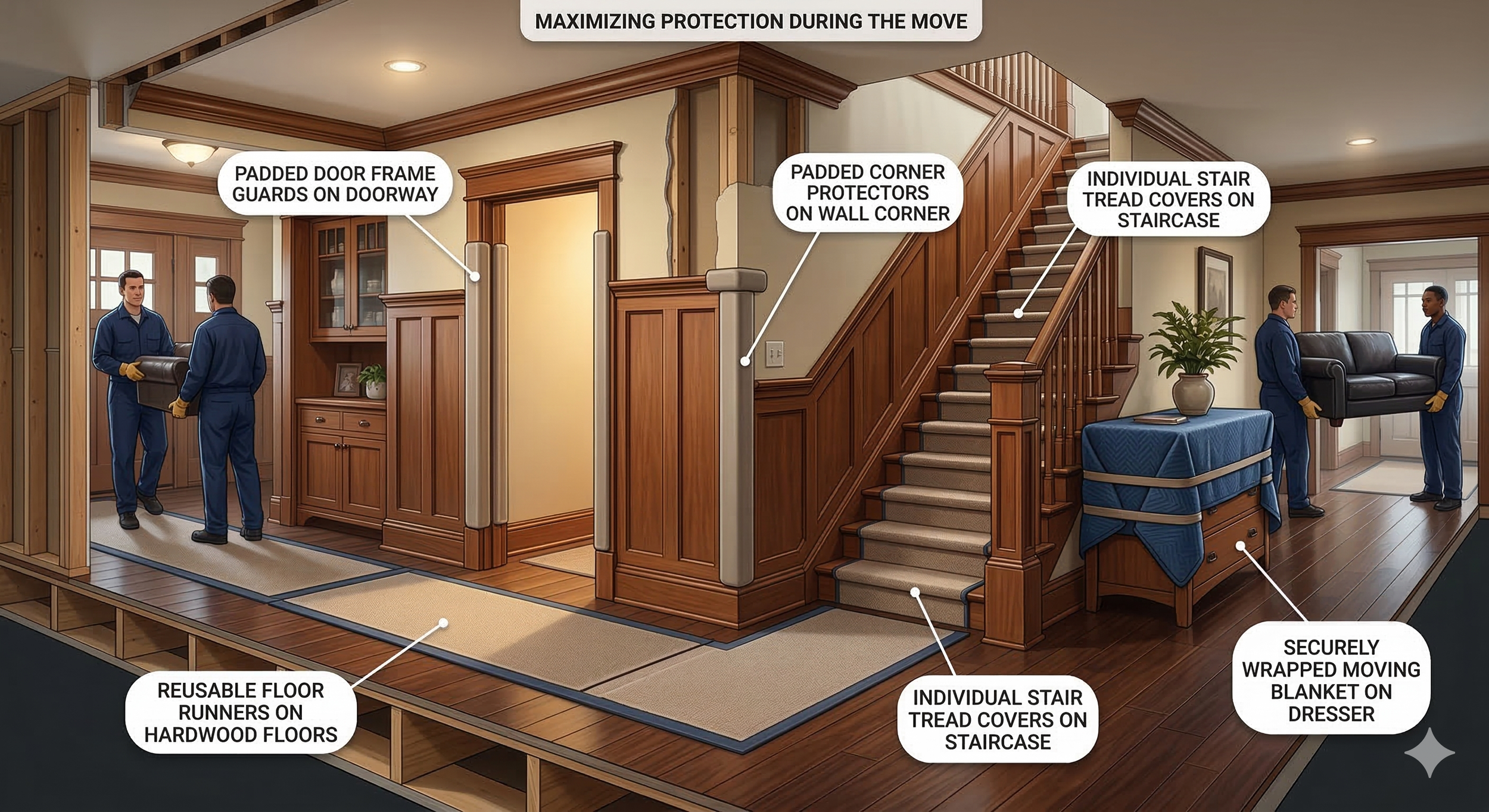
Property protection measures are listed below.
Floor runners go on hardwood, tile, laminate, and carpet before any item is moved across it.
Door frame guards are installed on all active doorways before large furniture or appliances pass through.
Corner protectors are placed on the wall corners along the removal path.
Stair treads protect staircase surfaces and reduce slip risk during heavy item removal.
Moving blankets wrap sharp-edged furniture, metal frames, and appliances to prevent wall and banister contact damage.
Any pre-existing damage is documented during the initial walkthrough. This protects both you and the crew from disputed claims after the job.
What Insurance Covers Junk Removal Crews?
Clark's Haul and Go carries full general liability insurance and workers' compensation coverage for every crew member on every job. General liability covers accidental property damage during service. Workers' compensation covers crew injuries on site, removing financial liability from the homeowner or property manager.
You can request proof of insurance before the job begins. Licensed, insured junk removal is a legal requirement in California for any company hauling waste commercially. Hiring an uninsured operator puts you at risk if a crew member is injured on your property.
When and How Do You Pay for Junk Removal?
Payment process and options are given below.
Payment timing: Payment is collected on-site after the job is complete and you finish the final walkthrough.
Accepted methods include cash, all major credit cards, Zelle, and Venmo.
No deposit required, no upfront payment is needed to confirm a booking.
Pricing basis, the final price is based on volume loaded, item type, and access conditions confirmed during the on-site assessment.
Price lock, the quote given after the walkthrough is the final price. No charges are added after work begins unless you add items not in the original scope.
What Receipts and Donation Records Does Junk Removal Give?
Clark's Haul and Go provides two documents after every job:
Payment receipt, issued after payment confirming the service date, items removed, and total charged.
Donation receipt, issued for items delivered to a registered 501(c)(3) nonprofit. It lists item descriptions and estimated fair market values. This supports charitable deduction claims under IRS Publication 526 for customers who itemize deductions.
Both receipts are sent digitally by email and available in paper form on request.
How Does Junk Removal Adapt to Special East Bay Situations?
East Bay homes and situations require special handling, here is exactly what to expect when standard conditions do not apply. The East Bay includes pre-war Victorian homes in Oakland, hillside properties with steep driveways, dense apartment buildings in Berkeley and Emeryville, and large estates in Danville and San Ramon. Each property type brings its own access and logistics needs.
Get a free quote from Clark's Haul and Go for any East Bay property type, residential, apartment, hillside, or commercial.
How Does Junk Removal Work for Apartments and Townhomes?
Apartment and townhome junk removal in the East Bay is explained below.
Elevator buildings, the crew contacts building management before arrival to confirm freight elevator access. Most East Bay apartment buildings need 24 to 48 hours notice for freight elevator reservations.
HOA requirements, many Contra Costa County townhome communities require proof of insurance and a service vehicle permit. Clark's Haul and Go provides both on request.
Parking in dense areas, in Berkeley, Emeryville, and parts of Oakland, the crew identifies loading zones or requests temporary parking authorization for the service window.
Upper-floor units without elevator access are assessed for stairwell width and load limits before the booking is confirmed.
How Does Junk Removal Handle Rain or Hillside Homes?
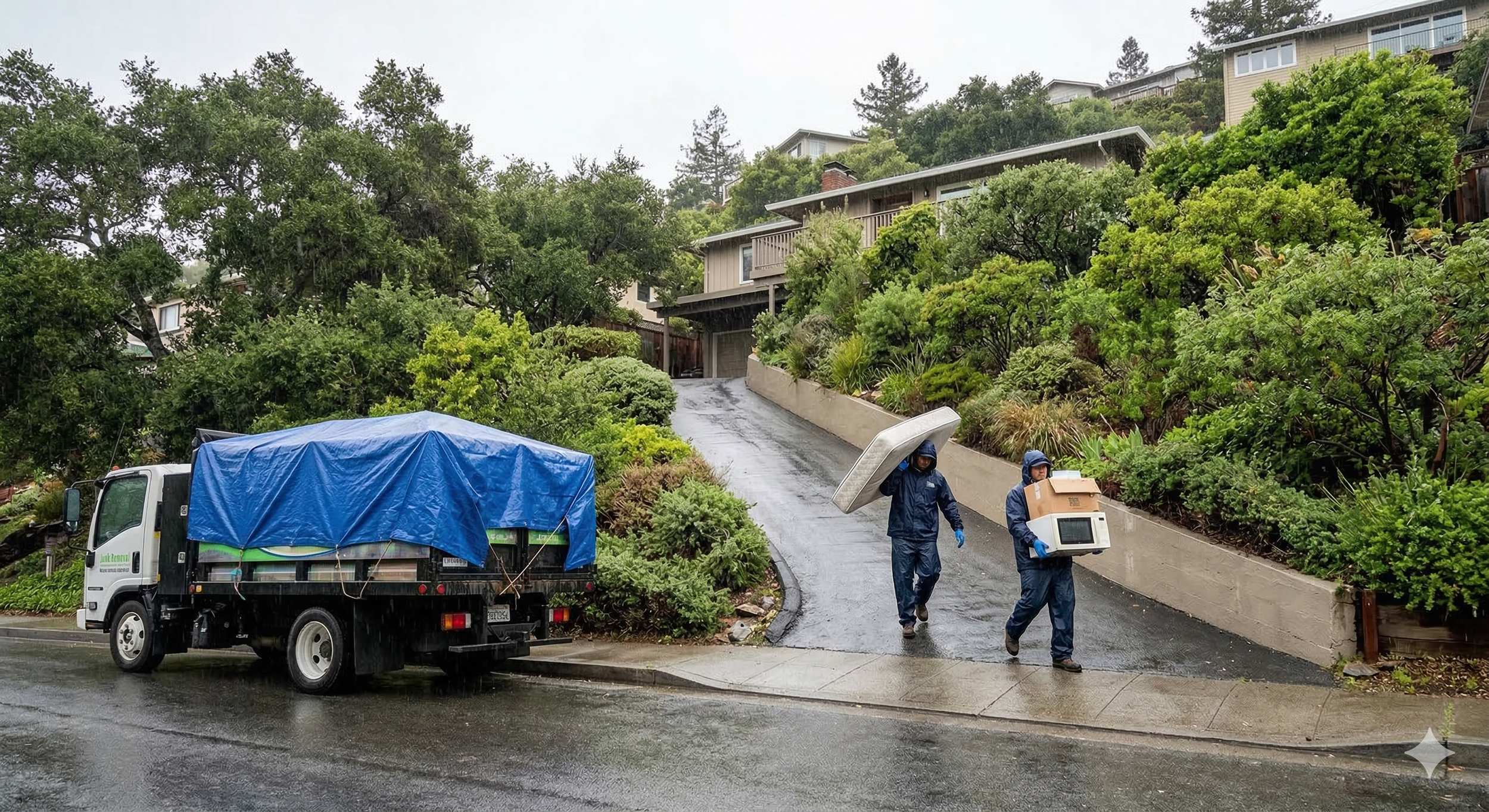
Rain is a regular East Bay condition from November through April. Wet conditions add 15 to 25% more time to most jobs due to these adjustments:
Extended floor protection to prevent water tracking across interior surfaces.
Non-slip shoe covers are worn by all crew members entering the property.
Slower item movement on exterior steps and wet driveways to prevent slipping.
Tarp coverage over loaded items during transit to prevent water damage.
Hillside properties in Oakland Hills, Orinda, Moraga, and Lafayette present grade and access challenges. Steep driveways limit the size of truck that can safely park on site. For grades over 15 degrees, the crew uses a smaller vehicle and performs additional carry runs from the property to a level parking spot nearby. Job time increases by 30 to 60 minutes on average for steep hillside access compared to flat-terrain properties.
Clark's Haul and Go is a locally owned, fully insured junk removal company serving Contra Costa County, Alameda County, and Northern California. Same-day service is available across the East Bay. Contact Clark's at brandon@clarkshaulandgo.com or call +1 925-506-1387 for your free on-site estimate.